Showing posts with label Tile quilts. Show all posts

Wednesday, January 25, 2012

Tile Crib Quilt


The last quilt in my exhibit was a Tile Quilt — 
signed "Donald 1944"  (50x33)


I'll have to take clearer photo when I get back. This is what I grabbed off eBay when I bought it.


This delightful find has the date 1944 embroidered on it plus the name Donald.


I first encountered what I am calling a "Tile Quilt" at the International Quilt Festival in Houston in an antique quilt dealers booth. I don't know that a firm name/term has yet been decided upon by quilt historians for this type of quilt. It caught my eye as I was cruising by and it was such an odd-duck I put on my brakes and took a photo.


I looked and looked at this quilt for the longest time until I finally realized....all those little pieces are just "left-over scraps" randomly placed in the maker's own "made-up" pattern. In some instance she was almost able to make it look like a snowflake-type pattern!

My 1944 Tile crib quilt really has no pattern to it but it was born of the same idea....left-over scraps randomly placed on a background fabric, no scrap too small or too oddly shaped to NOT use! AQSG friends Bobbi Finley and Carol Gilham published a book under C&T's banner in 2010 about another variation of this unusual pattern style — "The Tile Quilt Revival".


Here are a couple of links to my previous posts about Tile quilts. (Click on 2nd link here) .

Until next time, keep those needles flying! We don't want to run out of quilts to research and document!

KarenQuilt

Saturday, February 26, 2011

1950s Contemporary Fabric Designs


Some designs are so iconic they leap off the page at you and yell 1950s or 1960s.  Here is one example from Ann Champion's blog Quilt Top Cupboard.

By the way, Ann's blog is well worth bookmarking.

Click here to go to see the whole top and more details of this particular fabric.


The fabric in the above Cream and Teal Log Cabin top rather reminded me of a doll quilt I saw on eBay recently, so I began capturing photos so that I could compare them. 

The item eBay item number is 310219291510.  Or just click here to go directly to the auction. 

This 1950s doll quilt is 20x27 inches.

Here is a detail of the fabric in this little quilt.


 Somewhat similar to the fabric in Ann's quilt top, wouldn't you say?

This type of design is so familiar, so iconic to the "modern look" popular in the 1950s.  It will be a great dating clue for future historians documenting the quilts of this era.

Then I stumbled on another similar design on eBay. This seller referred to the design as a "Vanart stamped tea towel".  It's eBay Item number 150566514000. Or just click here to go to this eBay auction directly.


I have googled "Vanart" hoping to come up with some info about the designer of this "contemporary" '50s fabric but no luck so far. I suspect it may have been a French-Canadian designer. I thought I might find a similar photo of this style of design in Twentieth-Century Pattern Design by Lesley Jackson, but no luck there either.

At any rate, it looks very “European-modern” to me. I remember seeing this kind of art on magazine covers from the ‘50s when browsing in antique shops.

If you are familiar with this type of design or know where to find something similar on the Internet, please leave a comment to let the rest of us know where to look.

Meanwhile, happy sleuthing in your quilt and fabric studies!

KarenQuilt


UPDATE #1: Reader Tim Latimer just sent me another find from eBay of fabric from the 50s-60s era. Though the barnyard critters aren't a play on sophisticated strollers as in the other fabrics, it definitely has what today is called the "retro" look of the 50s-60s.


UPDATE #2 - March 2:  Just stumbled on a new blog today. (Only 3 million to go!) The Adventures of the Empress of the Universe....or how I learned to quilt on the Internet.  I particularly liked her post titled Bottling Rainbows.  You'll see some great examples of small Tile Quilts made from her leftover scraps, not unlike what I did with my little Signature Jazz Quiltlet but her quilt has a more tradtional tile layout format as seen in Bobbi Finley and Carol Gilham's The Tile Quilt Revival. Here is another interesting blog that is a mixture of quiltmaking and quilt history that comes from Holland --Quilting with the Past. Lucy also has experimented with Tile Quilts. Check it out.


Speaking of my Signature Jazz Quiltlet, I am so very pleased to share that it was one of five featured in today's The Wednesday Quilt Show on Jenifer Dick's blog Forty-Two Quilts. If you like red and green applique quilts, check out Jenifer's new book The Circuit Rider's Quilt.                                             

Monday, February 14, 2011

Jazz Signature Quilt and Yarn Bombing


Jazz and Quilts 
Have a Lot in Common!

Scanned art by KarenQuilt: 100% cotton and the
found "skeleton" of a leaf.

Click on any photo to enlarge.

The artists of both forms 
know how to incorporate "soul" 
into their work!


Dindga McCannon's "A Tribute to Charlie Parker" from Textural Rhythms: Quilting the Jazz Tradition by Dr. Carolyn Mazloomi.


See one of Dr. Carolyn Mazloomi's jazz and quilts exhibit here (http://www.jazzschool.com/html/events_live.html)

Click here to visit Carolyn's website to order one of her books.

Our First Jazz Cruise!

Just back from our first Jazz Cruise. What a fabulous experience! It was unlike any other jazz event I have ever attended with Gary. It wins hands down as the kind of venue in which I can enjoy experiencing jazz. 


Some of the members of the marvelous Clayton Brothers Quintet. L-R: Terrel Stafford, Jeff Clayton, and Gerald Clayton at piano.  Missing from the photo are bassist John Clayton and drummer Obed.

Below are signatures on fabric from the Clayton Brothers Quintet. Love the way John Clayton and the drummer added a little icon with their signature!

Their most recent recordings were nominated for Grammy awards for best Jazz Instrumental Album, Individual or Group "Brother to Brother" (artistShare, 2009).

Here and here are links to John Clayton playing with Diana Krall and another link to one of John's jazz workshops. Love this man!


I am not a hard core jazz fan. It's weird, but I have seldom had any music on in my office the past 10 years. I'm not quite sure why that is.

And I can't sit and listen to live jazz for more than one set at a club without getting restlesss...until now!! I have discovered the secret for me....having needlework in my hands.

Dark jazz clubs and concert halls do not readily lend themselves to executing needlework. The eye strain is terrible.

 
Love the saxaphone! L-R: Grant Stewart, Harry Allen, Ken Peplowski. All I can says is WOW!
Ken is also a wicked comic!! 


Then came The Jazz Cruise, which changed my whole experience of jazz!


I now know that if my hands are engaged, I can sit through set after set! In fact, the needlework actually helps me concentrate on the music!


Remember the small quilt (above) I told you about in my previous post that I rushed to put together to take on the trip?  Quite frankly, I am not sure if these were remnants from one of my mother-in-law's projects or of someone else's project that I was given since moving to this island. I didn't stitch or cut out any of these pieces myself. I just laid them out on plain muslin in a pattern that pleased me.
 
At any rate, I thought I was preparing a "doll" quilt to embroider while cruising, but once I started stitching, I realized it was really meant to be a small signature quilt for the musicians to sign!

And the more I looked at it, the more the "story" this little quilt wanted to tell began to come to me.

There are two pillars, one on either side of the central medallion which contains the original "flame" of jazz....THE HUMAN SOUL, if you will......THE PURE LOVE OF MUSIC AT THE HEART OF ALL who have the ear to hear!

The two pillars represent the incredible confluence of African rhythms --and its call and response-- with that of Western classical music. The checkerboard effect of these scraps represent (to me) how these two musical streams have experienced a long evolving journey through human history. The spark this confluence of musical streams ignited has evolves endlessly, just like our quilt art does!


So many wonderful musicians! 
And because of the venue, you actually get to talk with them one-on-one!


We were once again privileged to hear Freddy Cole --brother of Nat King Cole-- and to meet him in person this time...


as well as meet George Wein --founder of the Newport Jazz Festival. What an honor to have both sign my little quilt!


....Plus all but 2 of the female musicians and/or singers, including the marvelous Grammy winning Janis Siegel (who was there with her own Quartet) signed. Of course Janis is still singing with the original Manhattan Transfer group as well --going on 31 years now!  Manhattan Transfer is one of my all-time favorite singing groups. I first heard them while living in New Orleans in the 80s. The concert was outdoors at Audubon Park next to the zoo. I asked Janis if they knew ahead of time they were going to be riding elephants onto the concert grounds ---or was it a last minute surprise the organizers pulled on them?!! It was pretty much last minute surprise, she said, that they decided to go along with. I have to say as an audience participant, it was a pretty darn exciting entrance!!!

Janis was intrigued with the idea of a signature quilt when she went to sign it. Unfortunately, I had left my camera in the cabin the first four days of the cruise so I never got any photos of her. You can hear a song and see her here.


Talk About a Beautiful Soul!

I also heard Nnenna Freelon perform for the first time. Yes, you read right. It's spelled Nnenna.  Click here to read about her on Wickipedia.

Nnenna Freelon - WOW! What an incredible human being!
If you like jazz at all, you may have already heard of Nnenna. I haven't kept up with current jazz artists so she was new to me.  WOW!  Just click here and here to see some of her performances on YouTube. Once you go to the first one, more will come up on the right side of your screen. She is well worth a "visit".

Nnenna Freelonnominated for 6 Grammys, has a huge heart for arts education and loves talking about parenting. When she signed my little quilt she exclaimed, "Oh, a quilt! Don't people sometimes make quilts out of people's clothes? My sister and I want to do something with our Mama's clothes but we don't want to just give them all to Goodwill. Maybe we could make a quilt!" 


I told her I would be happy to connect her with someone who could help her get such a quilt made and that I could also help her document any quilts her mother or grandmother had made. Her eyes lit up and she asked if I had a card. I did! I hope she finds  time in her busy schedule to contact me or find someone else who might help her to realize this dream of a quilt made of her mother's clothes.

I also shared with almost a dozen women on the cruise about Dr. Carolyn Mazloomi, the Women of Color Quilt Network, Kyra Hicks and Cuesta Benberry.  You can read my tribute to Cuesta at her passing here. The transcript of Faith Ringgold's interview of Cuesta is here.


Two More Incredible Women Artists in the Field of Jazz New to me.


Italian Ada Rovatti (left) and Israeli Anat Cohen (right).


 See Anat on Wiki here.  Ada Rovatti  plays with the Randy Brecker Quintet.


Bucky Pizzerlli and his son John are two of our favorite guitarists. Bucky was on the cruise this year. John Pizzerelli will be on the cruise next year!


Bucky Pizarelli above


Our lovely dinner companions for the week of the cruise!


And here is a link to one of my newer posts about Jazz and Quilts!


Are you still in the mood for more color?

Have you heard about YARN BOMBING? I learned about it from a British gentleman on the cruise. He told me about it after he saw me stitching on my small quilt.


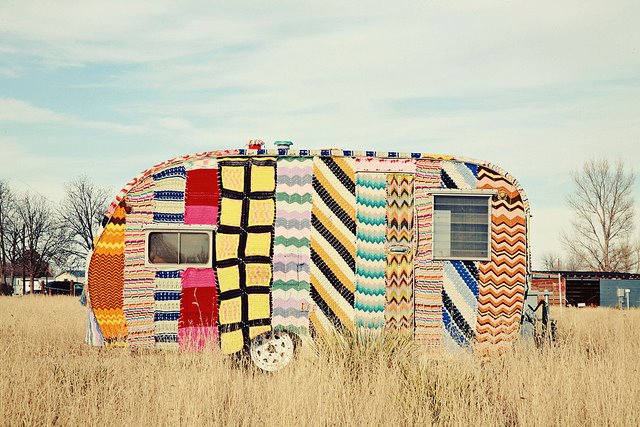
Take a peek at their blog. Some call it "stitching graffiti". Wikipedia even has an article about it. Click here to see it. Here are some marvelous photos of what knitters and crocherts are doing to spiff up public places as well as a talented fiber artist. It's a hoot and is spreading around the world!!

ANOTHER UPDATE: Finland's capitol is taken over by the Yarn Bombers  -


click here to see more photos from Finland.


Update from England


HAVING A GREAT YARN about Galway’s Biggest Coffee Morning are (l-r): Helen Jennings, Mary Somers, Aoife Burke, MaryJo Curran and Sandra Morrissey. These ladies are all part of the Athenry Craft and Chat group and they created this fantastic ‘Tractor Yarn Bomb’ to raise funds for Galway Hospice! Galway’s Biggest Coffee Morning will take place on Thursday next, September 20th, sponsored by Bewleys, in aid of Galway Hospice. You can still register as a Coffee Morning Host by contacting Galway Hospice, or you can register on-line at www.galwayhospice.ie

The ‘Tractor Yarn Bomb’ can be seen at the Eyrecourt Agricultural Show this Saturday 15th September, where the public will have an opportunity to view this fantastic work of art, and all donations on the day will go to Galway Hospice! Photo courtesy of Joe Travers Photography. — with Sandra Morrissey.


And a motorcycle!  Is there anything they won't cover with yarn?


And a bit of humor to close with....


Karen in the Islands

PS: Gary's jazz radio program --JoySpring of Jazz-- streams live on Mondays and Friday at 3-5:30pm PST or 6pm EST on KLOI Lopez Island. Click here http://www.kloi.org/ to find the live streaming link and listen via your computer. He also does a classical program!

PPS: My sweet husband fixed the most fantastic meal for me last night and did it ALL by himself! This was my Valentine surprise gift. His preparing a complete dinner is a rare event in 43 years of marriage. Who says an old dog can't learn new tricks!

Thursday, January 27, 2011

"Tile" Pattern Doll Quilt


In the last two photos of my last post, I showed you two very different "Tile" quilts.

Below is a close-up of one of the blocks in one of those quilts so that you can see the tiny bits of fabric the quilt maker used. Amazing, isn't it! She laid them out in a design and then button-hole stitched them down to the background, if I rememebr correctly. Tiny, tiny pieces in some cases!

(Click on the photo to enlarge.)

In the process of going through more inherited stuff this past week in my sewing room, I came across a small box which contained scraps of an experimental project.  Because I had just written about the Tile quilt pattern, I got the bright idea of turning these scraps into a Tile Doll Quilt.

Quite frankly, I am not sure if these are remnants from one of my MIL's projects or of someone else's projects that I was given since moving to Lopez. The handwriting on the papers in the box does not look like my MIL's.


I plan to have the finished size be about 17x15.


My AQSG quilt restoration friend Anne Dawson, who also lives here on Lopez, showed me how to adhere the tiny scraps to the background fabric using a tacky material that you press on.  Now I am ready to hand embroider around all the edges.

The two 20-patch squares are about 2 1/4 inches square! This is my "keep my hands busy" project when I am away from my computer or don't have a book in my hands.

The strips of tiny patches are 1 x 2 1/4 inches.

Each 4-Patch is about an inch square.


I am also taking along another doll quilt that I won at a fund raising auction in 2005. It needs quilting and a binding.  It will be interesting to see how much I actually get done on the cruise!  But I know I will need something to keep my hands busy while listening to the music.


These tiny little Nine-Patches are 1 3/8 inch square! 

Below is another even smaller embroidered quilt from the Rainbow Quilt Block Company.  Found this little jewel in May 2006. 


 Dolly Dingle was a favorite from the 1930s.  Just do a search on eBay and you will find all kinds of Dolly Dingle paper dolls. They have even reproduced her in fabric in the past couple of years. I believe these were also from the Rainbow Quilt Designs Company as were the Teddy Bears below.


You can still find all of these patterns today.


Here is another little treat for you from my collection. It is 13x18 inches.


My guess is that the patterns are from the Rainbow Company but I have yet to confirm this by finding them in a catalogue or an ad.  I love the strippy format!


Ah, the search is such fun!

Keep those needles flying!

KarenQuilt


Wednesday, January 19, 2011

More Crib & Doll Quilts


I am always grateful for an opportunity to share my quilts and our wonderful island library has given me my 2nd opportunity in two years to do so!

Lopez Island Library is a community run library and is the most enchanting library I have ever visited.  A lot of it has to do with the volunteers! The fact that it was once a one-room schoolhouse also adds to the charm. You can read its story here.

Photo courtesy of Lopez Island Library

Besides books, this amazing community library also makes musical instruments available for check out!


Crib and Doll Quilts - Full of History!

Click on photos to enlarge.


“Quaddie Quiltie” detail


1) “Quaddie Quiltie”
Pattern series by Ruby Short McKim
Design first available in 1916. 

This quilt bears a label on the back that reads: Carol Burr Baby quilt made for Richard born 1918.

Ruby Short McKim (1891-1976) studied art under the renowned Frank Alvah Parsons at the New York School of Fine and Applied Arts in New York City. Although the reason is not known for certain, finances probably had a lot to do with returning home.

Once home, Ruby began to teach in the public schools and in 1912 became the Supervisor of Drawing for the Independence School system, overseeing all grades elementary through high school.

“Bedtime Quilt”, or the “Quaddie Quiltie” series as it soon became known, launched McKim’s “official” career on May 7, 1916 in the Kansas City Star. It was her first published series. Quilt historians also believe it to be the first syndicated quilt pattern series.

Although the red sashing is badly worn in places, especially across the top border, I was thrilled to stumble upon such an early quilt of Ruby’s first series.

This first series was a joint copyright venture with well known author Thornton Burgess. Burgess, who died in 1965 at the age of 91, wrote over 170 books and 15,000 stories throughout his life.  His characters, such as: Peter Rabbit, Joe Otter, Hooty the Owl, Jerry Muskrat, and Bobby Raccoon are famous worldwide. It was an auspicious beginning to McKim’s career to land this joint venture.

Visit the resurrected the pattern business Ruby created! Her granddaughters are re-issuing all the patterns, each accompanied by a very special history booklet.

You can read my lengthily article on Ruby McKim here.


Colonial History - Another McKim Pattern


2) Colonial History
Pattern series by Ruby Short McKim. 
First appeared in newspaper syndication in 1930.

This quilt was probably made in the 1930s. What a great way to make history come alive to a child. What a great prompt for story telling at bedtime. When showing it to children, I always ask "How many of these scenes can you indentify?  Can you find George Washington?  What about Daniel Boone?"


One of America's Cultural Icons - the Cowboy!


3) Cross-stitched Cowboy Crib Quilt
Made ca. 1955-1965
Source of pattern still unknown at this time.

By studying quilt designs you can learn some great history along the way.

The word "cowboy" appeared in the English language by 1725. It appears to be a direct English translation of vaquero, a Spanish word for the man who managed cattle while mounted on horseback. It was derived from vaca, meaning "cow," which came from the Latin word vacca.


Another English word for a cowboy, buckaroo, is an Anglicization of vaquero. At least one linguist has speculated that the word "buckaroo" derives from the Arabic word bakara or bakhara, also meaning "heifer" or "young cow", and may have entered Spanish during the centuries of Islamic rule. Originally, the term may have been intended literally—"a boy who tends cows."


However, by 1849 it had developed its modern sense as an adult cattle handler of the American West. "Cowhand" appeared in 1852, and "cowpoke" in 1881, originally restricted to the individuals who prodded cattle with long poles to load them onto railroad cars for shipping. Read more of Wikipedia's great article on cowboys and cowgirls here.

The following is from Texas Quilts, Texas Women by Suzanne Yabsley.

Part of a cowboy’s gear was the bedroll… During a trail drive the men often worked a 16-20 hour day…Bedding had to be portable and uncomplicated. The Texas cowboy’s bedroll was often a heavy quilt, which he called a suggan.  Suggans were made from old wool pants, tailors squares. Or the legs of khakis or blue jeans….Some old timers relate that the cowboys themselves sometimes helped “tack” their suggans. One former ranch hand recalls the general use of this type of quilt and remembers hearing cowboys say, after a hard day’s work, “I can’t wait to get into them suggans!”


Mostly Doll Quilts


This space in the library is perfect for doll quilts.


4) Rectangles
Doll Quilt circ 1920s
Made on a sewing machine

Modernism — the Art Deco designs in the lightweight fabrics in this little quilt are wonderful. I have never seen a doll quilt with such a marvelous array of them.


5) Windmill
Doll Quilt circ 1920s
Made on a sewing machine

The actual name for this pattern depends upon the light and dark fabric choices and their placement.  I simply call it Windmill. Someone else might see a flower or star in it and give it a different name. If you turned the setting one tick to the right, it could possible be called a Maltese Cross variation.


(6) Rainbow - One Patch Square
circa 1930 Doll Quilt
Machine sewn

The arrangement of this cascading sherbet color scheme had a popular variety of arrangements in the ‘30s. This little jewel needs some TLC as the lightest colored fabric has split.


7) Purple Square
Doll Quilt circ 1940s-50s
Made on a sewing machine

This is a simple Nine Patch pattern with three nine-patch blocks across and three down with sashing added at top only. The final effect or design comes from the choices you make in the placement of your lights and darks.  It is an easy pattern to play with if you like to experiment with color!


8) Log Cabin
Doll Quilt circa 1900-1930
Made on a sewing machine

It is interesting to study the color changes that occurred in fabrics between 1890 and 1920.  The lighter plaids and stripes had begun to show up just before the turn of the century but it really wasn’t until after 1905 that they became the rage for use in every day dresses and children’s clothing. Virginia Gunn presented an excellent paper at the 2007 American Quilt Study Group Seminar on early 20th century quilts — "The Gingham Dog or the Calico Cat: Grassroots Quilts of the Early Twentieth Century." The fabrics in this little quilt are a perfect example of the quilts she wrote about. 

This is a variation of the Log Cabin pattern that became quite popular just after the Civil War and remained so for a very long time. This variation is quite simple to make and a good one to start a beginner on.


(9) Red Pillars
circa 1890-1910
Machine sewn

This charmer is a combination of some very traditional patterns. Again these two patterns have had a number of different names. The purple could be a Square-in-a-Square. The cadet blue corner blocks could be Flower Basket. What makes this quilt “zing” are the two red strips. I personally like the lack of “striving for perfection” in the matching of seams in the older quilts. It imbues them with a greater feel of warmth in my humble opinion.


10) Sunbonnet Sue and Scottie
Crib quilt early 1950s

Scotties (and West Highland Whites) were very popular in the USA from the 1920s through the 1950s. President Franklin Delano Roosevelt’s famous Scottie (Fala) brought the breed to the public’s attention once more but did not create the Scottie sensation in the USA to begin with.

Girls in bonnets were first popularized in 1878 by the publication of Kate Greenway first illustrated book. In 1884 the first knock-off Kate Greenway illustrations were published for needlework. Bertha Corbett self-published her first illustrated storybook The Sunbonnet Babies in 1900.  Her book caught the attention of Eulalie Osgood Grover, a writer of children's school primers.  Bertha was hired as the illustrator of Ms. Grover's primers series which became The Sunbonnet Babies Primer series. 


Bernhardt Wall, another early 20th century artist, also got into the act and created his own distinctive bonneted little girls. Over the last century both Corbett’s and Wall’s simplified designs have been adapted for Redwork embroidery.

Sunbonnet Sue as an appliquéd figure became popular beginning in the early 1930s and remains so today. In the 1930s outline black embroidery was often added around appliquéd figures

This particular crib quilt is not as finely made as most you will see from the 1930s. It is rather awkwardly embroidered in a blanket stitch around the appliqué. It is a very thick quilt, yet hand quilted. It is the first Sunbonnet Sue quilt I have personally seen with the Scottie dog added.


Click on the photo twice to see the stitching up close. You can see how she first outlined each dog and child in a black running stitch. Then she stitched a blanket stitch around each figure, crude though it may be compared to most examples of outlined applique of this period.


One of the members of the Quilt History List told me that she is reasonably certain the pattern came from one of the Colonial Pattern series booklets from the 1950s. She further added that Betty Hagerman cited this pattern in her book, A Meeting of the Sunbonnet  Children. The children are featured in various poses including with butterfly, watering can and balloon, etc.  One of the poses includes a girl in similar garb bending over a Scotty dog.  Another pattern to track down and add to my documentation!


The last quilt in the exhibit — Donald's 1944 Tile Quilt (50x33)


I'll go back to the library and take clearer photos tomorrow. This is what I grabbed off eBay when I bought it.


This delightful find has the date 1944 embroidered on it plus the name Donald.


I first enountered a Tile Quilt at the International Quilt Festival in Houston in an antique quilt dealers booth. It caught my eye as I was cruising by and it was such an odd-duck I put on my brakes and took a photo.


I looked and looked at this quilt for the longest time until I finally realized....all those little pieces are just "left-over scraps" randomly placed in the maker's own "made-up" pattern. In some instance she was almost able to make it look like a snowflake-type pattern!


My 1944 Tile crib quilt really has no pattern to it but it was born of the same idea....left-over scraps randomly placed on a background fabric, no scrap too small or too oddly shaped to NOT use! AQSG friends Bobbi Finley and Carol Gilham published a book under C&T's banner in 2010 about this unusual pattern style — "The Tile Quilt Revival".

Until next time, keep those needles flying! We don't want to run out of quilts to research and document!

KarenQuilt

PS:  Want to see still more doll quilts?

http://edythoneill.blogspot.com/2011/11/lovely-doll-quilts-antique-and-new.html